Materialer og sikkerhed
What it is made of, and what it may touch
Every piece in this range is a food contact article. That puts it under EU framework Regulation 1935/2004 and, because it is ceramic, under the lead and cadmium migration limits of Council Directive 84/500/EEC. This page explains the rules, which category each piece falls into, and how to ask for the paperwork.
Last updated 13 August 2026 · Governing law: Denmark
The framework: Regulation (EC) 1935/2004
Anything intended to come into contact with food must not transfer its constituents into that food in quantities that could endanger health, change its composition, or spoil its taste or smell. It must be traceable back through the supply chain, and it must be covered by a declaration of compliance issued by the manufacturer.
Each piece on this site carries its declaration reference on its product page, in the form DoC/SL-2026/…. A copy is sent on request to support@ancherstudio.shop — you do not need to be a customer to ask.
Packaging carries the glass-and-fork symbol, the internationally recognised marking for materials intended for food contact.
Lead and cadmium: Council Directive 84/500/EEC
Ceramic ware is regulated separately because glazes historically carried lead and cadmium compounds. The limits depend on the shape of the article rather than on what it is called — how deep it is and how much it holds — so a deep plate and a flat plate are held to different figures.
| Category | Applies to | Lead | Cadmium |
|---|---|---|---|
| Category 1 — flat or shallow | Articles that cannot be filled, and fillable articles with an internal depth of 25 mm or less. | 0.8 mg/dm² | 0.07 mg/dm² |
| Category 2 — fillable, deeper than 25 mm | Fillable articles with an internal depth greater than 25 mm and a capacity of 3 litres or less. | 4.0 mg/L | 0.3 mg/L |
| Category 3 — cooking ware and bulk vessels | Cooking ware, and packaging or storage vessels holding more than 3 litres. | 1.5 mg/L | 0.1 mg/L |
The category is derived in code from the measured internal depth and capacity of each piece, not typed in by hand, so a product page cannot quote a limit that does not apply to it. Every product page prints its own category and the two figures that go with it.
The glaze
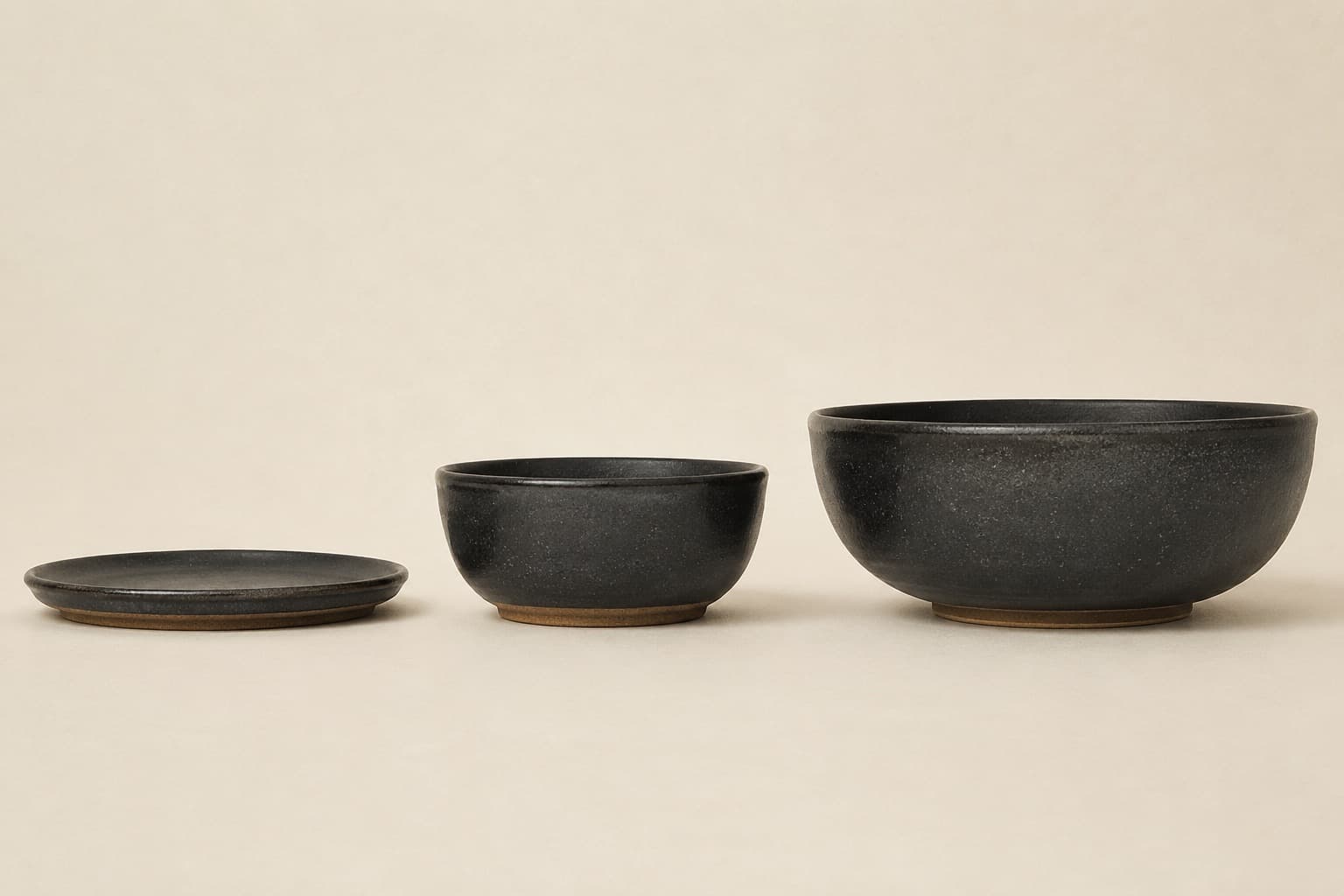
One glaze runs through the whole range: Charcoal satin SL-G1, a lead-free and cadmium-free feldspathic glaze, single-fired to 1,240 °C. The foot ring is left unglazed, which is the honey-brown clay you can see on every piece.
No piece in this range carries a metallic or lustre decoration. Where a piece ever does, its page marks it as unsuitable for the microwave and that marking cannot be switched off.
Stoneware, and how it differs from porcelain
We sell stoneware. It is a coarser, iron-bearing clay body fired to around 1,240 °C, which vitrifies it to a low porosity but not to translucency. It carries a heavier section, holds heat longer and takes a knock better than a thin body would.
Porcelain is a different material with a different clay body, fired higher, thinner in section and translucent when held to the light. The two are not interchangeable and we do not use the words as if they were. If a supplier uses them loosely, that is a reason to ask which one you are actually being sold.
Limits on use
- Microwave. Suitable unless the product page says otherwise. A piece with metallic decoration is never suitable.
- Dishwasher. Suitable across the range. Cycle testing is described on the durability testing page.
- Oven. Only the pieces whose page states an oven ceiling — the oval baker, the gratin dish and the ramekin, all rated to 220 °C. Put them into a cold or warm oven, never a preheated one above 180 °C.
- Never on a hob, under a grill element, over an open flame, or in a pressure cooker.
- Thermal shock. Fired ceramic moves when the temperature moves. Let a piece reach room temperature before it meets a hot oven, and let it cool on a rack rather than under cold water. We publish tested cycle counts with their conditions; we make no absolute claim about temperature change and no piece here is sold as immune to it.
- Salt. Salt is corrosive to unglazed clay. Empty and dry the salt cellar between services rather than leaving salt standing in it.
Handmade tolerance
A tolerance of ±5% applies to every published dimension. Glaze pooling where the surface thickens, the fine pinholes characteristic of a satin glaze, and colour movement between firings are properties of the process. They are not faults, and they are not covered by the right to complain. Colour movement between glaze batches matters most when you are replacing one piece in a set — that is covered on the resupply page.
Cleaning
Dishwasher or hand wash, both fine. A satin glaze picks up fine grey cutlery marks over time, the same as any matt-glazed ware; a cream cleaner and a soft cloth take them straight off. Avoid scouring powder and steel wool, which will dull the surface permanently.
Where they are made
Designed in Denmark, made in Poland. The forms, sections and glaze are specified in Frederiksberg; the pieces are thrown and fired by a family stoneware workshop in Poland. Both facts appear together on every product page.
Packaging and recycling
Cartons are unbleached corrugated board, the trays are moulded paper pulp and the separators are fluted card. All of it goes in paper and cardboard recycling. There is no plastic film, no expanded polystyrene and no adhesive tape that has to be picked off first.