The workshop
We publish the measurements
instead of the story.
Most tableware is sold on how it was made. This range is sold on what it does: how tall the stack is, how thick the rim is at its thinnest point, how many wash cycles the glaze survived before it moved, and whether you can buy one piece back in two years’ time. Those are the questions a working kitchen asks, and they are the ones almost nobody answers.
Where it comes from
Servicelab is the tableware range of Ancher Studio ApS, a design company in Frederiksberg, Copenhagen. The forms, the wall sections, the stacking geometry and the glaze specification are drawn here.
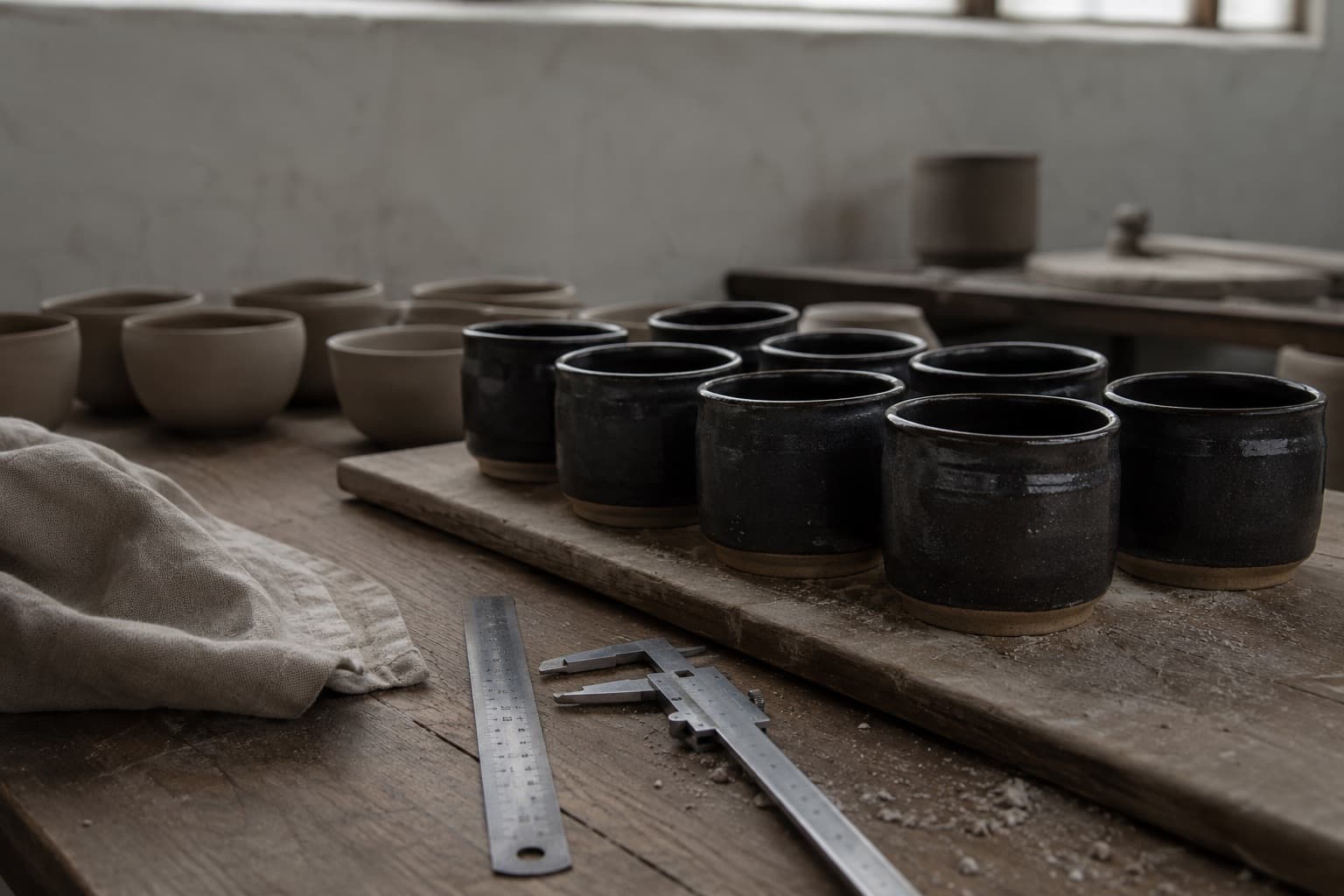
The pieces themselves are thrown and fired by a family stoneware workshop in Poland that has been working in the same building for three generations. That is where the kilns are, where the clay body is prepared and where the glaze is mixed batch by batch. Choosing a workshop with that depth of practice is the reason the sections are consistent enough to publish a rim measurement at all.
Designed in Denmark. Made in Poland. Both facts appear together on every product page, in the footer and on this page, because printing one without the other would let you draw a conclusion that is not true. Danish design is a fact about where the drawing happens. It is not a fact about where the kiln is, and we do not let it stand in for one.
Why open stock
A sixteen-piece service becomes useless one plate at a time. Two years in you are three plates short, the pattern has been discontinued, and the only route back is buying sixteen more. That is the ordinary lifecycle of tableware and it is a bad one — for the person who has to buy it again, and for what happens to the thirteen pieces that were still perfectly good.
So the range is built the other way round. Every piece is sold singly. The forms do not get quietly redrawn between production runs. When something is going out of production it is marked before the stock runs down, not after, and it names what takes over.
What we do not do is promise a piece will be available indefinitely — that is a promise about a decade nobody can see. The boundary is written out in full, including the one thing everybody discovers too late: hand-mixed glaze varies between batches, so a replacement piece will be close but not identical.
Why the numbers have conditions
It would be easy to write that these pieces survive the dishwasher and resist thermal shock. It would also be meaningless, because there is no standard behind either phrase and a fired ceramic cannot honour the absolute version of them.
So every figure on this site travels with the protocol that produced it: what temperature, what detergent, how many pieces, what counted as the end. You will not find a single absolute claim about durability anywhere here — not on a product page, not in the marketing copy, not in the metadata. There is a build step that fails the deployment if one appears. The protocols are published in full.
Company
- Legal name
- Ancher Studio ApS
- Trading as
- Servicelab
- Registered address
- Godthåbsvej 24, st.
2000 Frederiksberg
Denmark - Customer service
- support@ancherstudio.shop
+45 26 83 51 47
Monday to Friday, 09:00–16:00 (Europe/Copenhagen)
Company registration and tax identifiers are published on the terms of sale, together with the full conditions of purchase.